
Views: 0 Author: Site Editor Publish Time: 2026-08-06 Origin: Site


Choosing between 40Cr and 52100 stainless steel balls usually comes down to one question: does your application involve precision rolling contact, or general mechanical duty?
Here is the short answer. AISI 52100 (GCr15) is a high-carbon chromium bearing steel that through-hardens to HRC 60–66, which makes it the standard choice for bearings and any high-load rolling application. 40Cr (equivalent to AISI 5140) is a medium-carbon alloy steel that reaches a lower hardness — typically HRC 28–35 after quenching and tempering, or around HRC 50–55 at the surface with additional surface hardening — but offers better core toughness at a lower price. If you need precision and fatigue life, choose 52100. If you need impact resistance and economy in a non-critical role, 40Cr is often enough.
The rest of this guide breaks the comparison down in detail — composition, heat treatment, wear performance, precision grades and cost — and ends with a five-question checklist you can use to decide.
| Property | 40Cr Steel Balls | 52100 Steel Balls |
|---|---|---|
| Steel type | Medium-carbon alloy structural steel | High-carbon chromium bearing steel |
| Grade equivalents | AISI 5140, 41Cr4 / 1.7035, SCr440 | GCr15, 100Cr6 / 1.3505, SUJ2 |
| Carbon content | 0.37–0.44% | 0.95–1.05% |
| Chromium content | 0.80–1.10% | 1.40–1.65% |
| Typical hardness | HRC 28–35 (quenched & tempered); up to ~HRC 50–55 surface-hardened | HRC 60–66, uniform through the section |
| Wear resistance | Moderate | Excellent |
| Impact toughness | Good | Moderate at full hardness |
| Common precision grades | G20–G200 (or as-forged for grinding media) | G10–G1000 per ISO 3290 |
| Corrosion resistance | Low — will rust unprotected | Low — will rust unprotected |
40Cr is one of the most widely used alloy structural steels in the Chinese GB standard. Its closest international equivalents are AISI 5140 in the United States, 41Cr4 (1.7035) in the European EN system, and SCr440 in Japan. The typical composition is 0.37–0.44% carbon, 0.80–1.10% chromium, 0.50–0.80% manganese and 0.17–0.37% silicon.
With roughly 0.4% carbon, 40Cr is a classic quench-and-temper steel: after heat treatment it delivers a good balance of strength, toughness and moderate wear resistance. The chromium addition improves hardenability and wear performance compared with plain carbon steels such as AISI 1045. In machinery, 40Cr is the everyday material for gears, shafts, spindles and fasteners under medium loads.
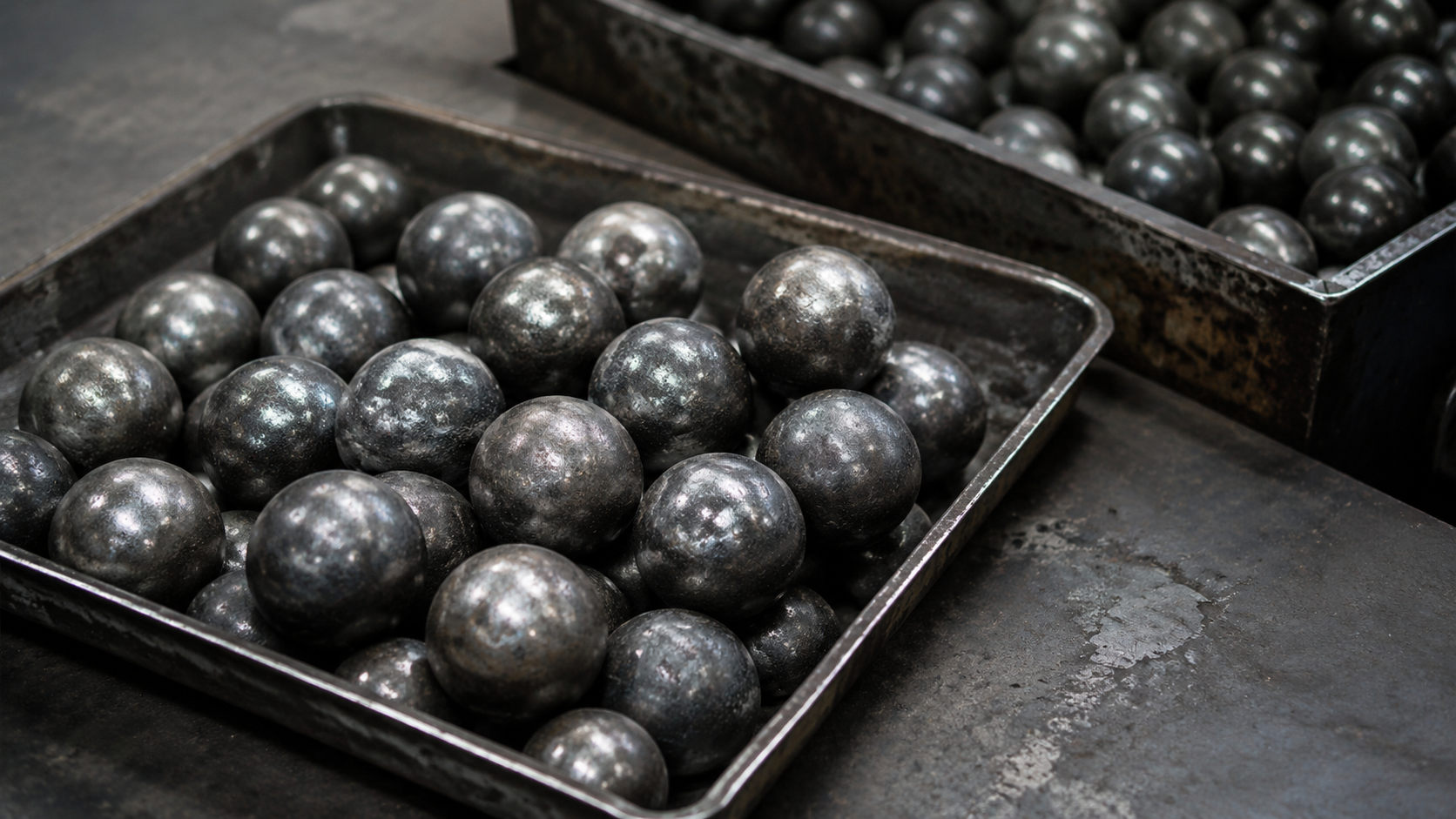
As a ball material, 40Cr steel balls are the economical choice where full bearing-grade hardness is not required. Typical uses include grinding media balls for ball mills, transmission and locking mechanisms, agricultural and mining machinery, and general-purpose hardened steel balls for rolling or filler duty. It belongs to the broader family of alloy steel balls, which are usually supplied quenched and tempered, with surface hardening available when a harder skin is needed over a tough core.
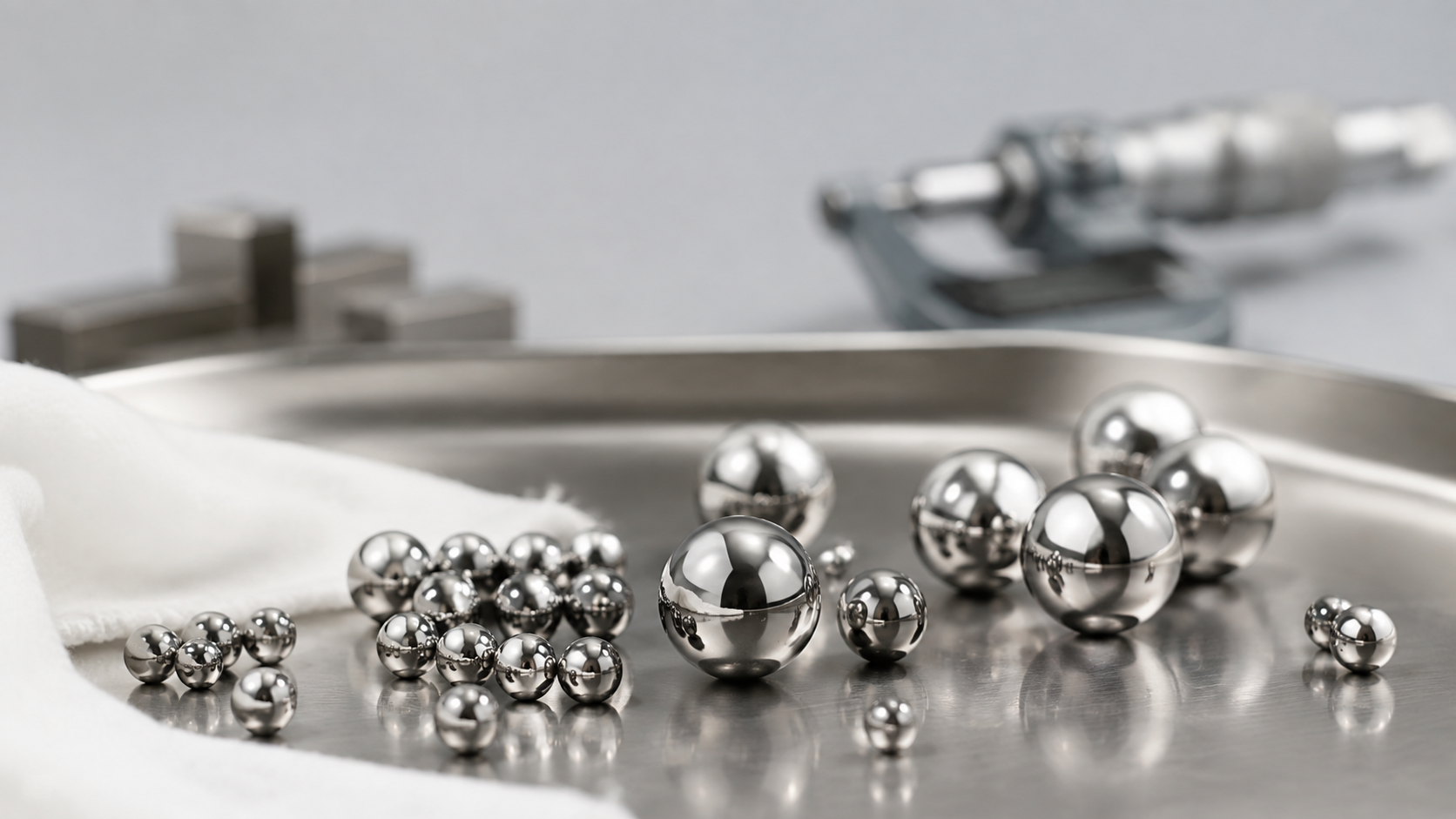
AISI 52100 — often simply called chrome steel — is the world’s classic bearing steel, in continuous industrial use for more than a century. It is known as GCr15 in China, 100Cr6 (1.3505) in Europe and SUJ2 in Japan — different names for essentially the same high-carbon chromium steel, with about 0.95–1.05% carbon and 1.40–1.65% chromium.
That high carbon content is what sets 52100 apart. After oil quenching and low-temperature tempering, the microstructure consists of hard martensite with finely dispersed chromium carbides, giving a uniform through-hardness of HRC 60–66 together with outstanding resistance to rolling contact fatigue. Bearing-quality 52100 is also produced to strict cleanliness standards — vacuum degassed, with tight limits on oxygen content and non-metallic inclusions — because fatigue life in rolling contact is highly sensitive to microscopic inclusions in the steel.
This combination is why 52100 / GCr15 chrome steel bearing balls are the default rolling elements in ball bearings worldwide, as well as in ball screws, linear guides, CV joints and other high-load precision assemblies.
The defining difference between these two steels is carbon: 52100 contains more than twice as much as 40Cr. Carbon is what allows steel to reach high hardness during quenching, and the extra chromium in 52100 ties part of that carbon up as hard, finely dispersed chromium carbides that act as microscopic wear-resistant particles. 40Cr’s lower carbon means it can never match 52100’s hardness — but the same lower carbon is what gives it a tougher, more forgiving character under impact.
52100 balls are through-hardened: oil quenched from around 840–860 °C and tempered at a low temperature (roughly 150–180 °C), producing HRC 60–66 across the entire cross-section, not just a hard skin. Every point on and below the ball surface has full bearing hardness.
40Cr is normally quenched and tempered at a higher temperature to preserve toughness, which yields roughly HRC 28–35. Where a harder working surface is required, 40Cr balls can be surface-hardened (for example by induction hardening or quenching with a low temper) to about HRC 50–55 at the surface while the core stays tough. Even at its best, a 40Cr ball runs roughly 10 HRC points below a 52100 ball — and in wear terms, 10 HRC points is a large gap.
In rolling contact, the life-limiting failure mode is surface fatigue: contact stresses in a loaded ball bearing routinely exceed 2 GPa, and after millions of stress cycles the surface eventually spalls. Here 52100 is in a different class. Its high hardness, carbide-reinforced microstructure and bearing-grade cleanliness give it far longer fatigue life at high contact stress. A 40Cr ball in the same duty would indent, wear and spall much sooner. 40Cr performs acceptably where contact stresses are lower, speeds are modest, or the motion is intermittent or sliding rather than continuous high-speed rolling.
Toughness runs the other way. Because of its lower carbon content, 40Cr absorbs impact energy better and resists chipping and cracking under repeated blows — one reason medium-carbon low-alloy steels are popular for grinding media in ball mills, where balls hammer against ore and each other all day. Fully hardened 52100, by contrast, trades toughness for hardness: under severe impact or shock loading it is more prone to chipping. If your balls take hits rather than roll under load, 40Cr’s toughness is a real advantage.
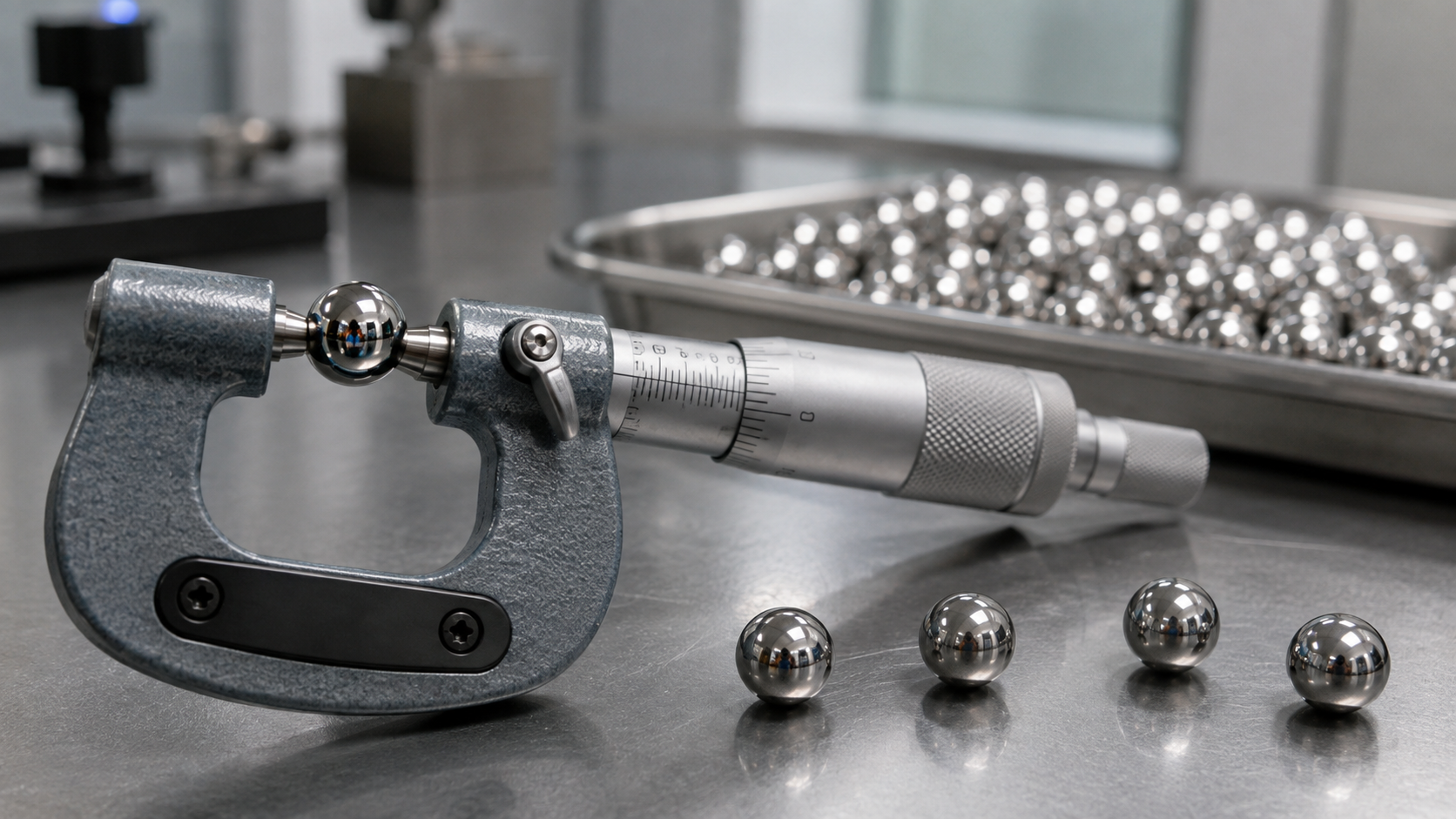
Steel balls are graded under ISO 3290, where a lower G number means tighter tolerances on diameter, sphericity and surface roughness. Because 52100 is the standard bearing material, it is routinely lapped to fine grades — high-precision G10–G100 chrome steel balls for bearing work, with surface roughness down to Ra 0.02–0.05 µm. 40Cr balls are usually supplied in G20–G200, or simply forged and ground when used as grinding media, where perfect sphericity is irrelevant. As a practical rule: if your drawing calls for G25 or finer, you are already in 52100 territory (or stainless / ceramic for special environments).
40Cr is the right call when toughness and budget outrank precision and peak hardness. Typical applications include grinding media for ball mills in mining and cement plants, where impact resistance matters more than sphericity; low-speed, lightly loaded rollers and transfer units; detents, locking and indexing mechanisms in machinery and hardware; transmission components under moderate wear; and counterweight, filler or structural balls where the ball simply has to be solid, round and affordable. In these roles, paying for bearing-grade 52100 buys performance the application will never use.
52100 is the only sensible choice once real rolling contact enters the picture: deep groove, angular contact and thrust ball bearings; ball screws and linear guides; automotive CV joints, steering and seat-slide mechanisms; castors and slewing components under high load; flow-control valve balls in non-corrosive media; and measuring or checking instruments that demand stable, precise dimensions. Whenever contact stresses are high, speeds are significant, or the specification calls for a fine precision grade, the extra cost of 52100 repays itself many times over in service life.
| Question | If yes → |
|---|---|
| 1. Will the balls roll under load at speed (bearing-type duty)? | Choose 52100 |
| 2. Does the drawing require precision grade G25 or finer? | Choose 52100 |
| 3. Is the dominant load impact or shock rather than rolling fatigue? | Choose 40Cr |
| 4. Is the application non-critical and cost-driven? | Choose 40Cr |
| 5. Will the balls run wet or in corrosive media? | Choose neither — look at stainless or ceramic |
Both grades are commodity products, but quality varies widely between steel ball suppliers — especially for bearing balls, where steel cleanliness and heat-treatment control decide fatigue life. When evaluating a steel ball manufacturer, check five things: certified raw material (bearing-quality GCr15 / 52100 wire or bar with mill certificates); in-house heat treatment with batch-by-batch HRC hardness testing; a genuine precision range — a factory that can lap G10–G100 balls has fundamentally better process control than one limited to G500; quality-system certification such as ISO 9001 and IATF 16949, backed by third-party testing (SGS); and custom capability for non-standard diameters, special grades and mixed orders from one source.
A large share of the world’s steel balls is produced in China, and an experienced China steel ball factory can usually supply both 40Cr alloy steel balls and 52100 chrome steel bearing balls in bulk at competitive prices with short lead times. The key is verifying the certifications and test reports above — not just the quoted price per kg — before placing a volume order.
They are near-equivalents. 40Cr is the Chinese GB grade; AISI 5140 (USA), 41Cr4 / 1.7035 (Europe) and SCr440 (Japan) cover essentially the same medium-carbon chromium steel. The composition ranges differ slightly between standards, but for most engineering purposes the grades are interchangeable.
Finished 52100 (GCr15) balls are through-hardened to HRC 60–66 by oil quenching and low-temperature tempering. This hardness runs through the full cross-section of the ball, not just a surface layer, which is essential for resisting rolling contact fatigue in bearings.
Not in standard precision rolling bearings. At HRC 28–55, 40Cr lacks the hardness and fatigue resistance to survive bearing contact stresses, and it would indent and spall early. 40Cr balls are fine in slow, lightly loaded, non-critical rotating or sliding assemblies — but where a real bearing duty exists, use 52100.
40Cr balls are cheaper per piece — the steel carries less alloy, does not require bearing-grade vacuum-degassed melting, and needs less precision finishing. However, in rolling-contact service 52100’s much longer fatigue life usually makes it the cheaper choice per hour of operation.
Yes. GCr15 (China), AISI 52100 (USA), 100Cr6 / 1.3505 (Europe) and SUJ2 (Japan) are the same high-carbon chromium bearing steel under different national standards, with only minor differences in the specified composition ranges.
Yes — both are low-alloy steels with far too little chromium to be stainless, so both will corrode if unprotected. Balls are normally shipped with an anti-rust oil coating. For wet or corrosive environments, specify stainless steel (304, 316, 440C) or ceramic balls instead.
Directly from a certified steel ball factory. China steel ball manufacturers such as RISHENG supply both grades in bulk — 52100 / GCr15 chrome steel bearing balls in 0.8–25.4 mm and 40Cr alloy steel balls in 0.5–100 mm — with mill certificates, SGS test reports and free samples before volume orders.
Yes. Beyond standard metric and inch sizes, a capable precision steel ball manufacturer can produce custom diameters, precision grades from G10 to G1000, and special heat treatments, including small trial batches. Send a drawing or specification and you will normally receive a feasibility answer and quote within one or two working days.


